I Let a Homeless Lady That Everyone Despised Into My Art Gallery – She Pointed at One Painting and Said, ‘That’s Mine’

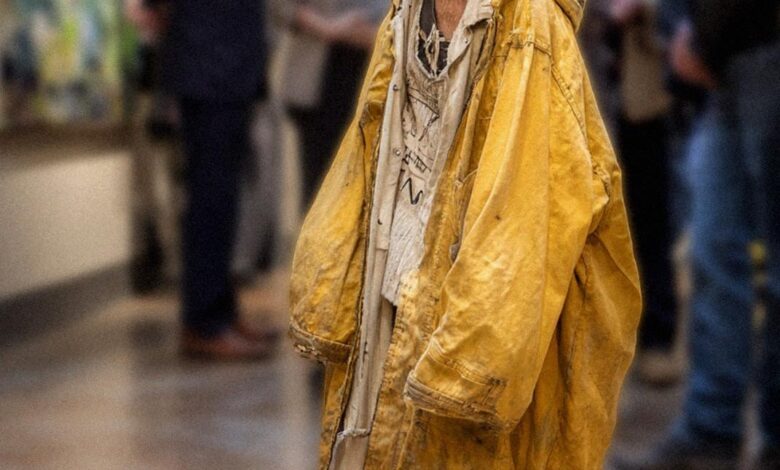
She walked in soaked, ignored, and judged—then pointed at a painting and said, “That’s mine.”
I had no idea then that believing her would turn my gallery upside down.
My name’s Tyler. I’m 36, and I run a small art gallery in downtown Seattle—quiet, warm, the kind of place that smells faintly of wood polish and jazz. I opened it after my mom died. She was an artist. I couldn’t paint after losing her, so I built a place for people who still could.
That Thursday afternoon was gray and wet when I noticed an older woman standing outside, hesitating. Her coat was thin, her hair flattened by rain, her posture folded inward like she was used to being overlooked.
Before I could decide what to do, three regulars walked in—well-dressed, confident, sharp-tongued. The moment they saw her, the whispers started.
“She doesn’t belong here.”
“Look at that coat.”
“Can you get her out?”
I didn’t. I let her in.
She walked slowly through the gallery, studying the art with an intensity that silenced the room. She wasn’t confused—she was remembering.
Then she stopped at a large skyline painting glowing with sunrise colors.
“That’s mine,” she said quietly. “I painted it.”
Laughter followed. Cruel, dismissive.
But she didn’t react. She simply lifted a trembling finger and pointed to the corner of the canvas.
There it was—barely visible beneath the glaze: M.L.
I’d bought that painting at an estate sale years earlier. No records. No artist. Just initials.
I asked her name.
“Marla Lavigne.”
We sat. She told me about the fire. The studio she lost. Her husband who didn’t survive. The man who took her work and sold it under his name while she faded into poverty and invisibility.
That night, I couldn’t sleep.
With my assistant’s help, I dug through archives and catalogs until I found proof: a 1990 gallery brochure. A photo of Marla standing beside the painting. The title printed clearly beneath it.
Dawn Over Ashes — by Marla Lavigne.
When I showed her, she cried—not loudly, just like someone realizing they hadn’t been erased after all.
We corrected records. Pulled mislabeled pieces. Contacted auction houses. And when the man who stole her work showed up angry and threatening, the evidence spoke louder than he could. He was arrested weeks later.
Marla didn’t celebrate.
“I don’t want revenge,” she said. “I just want my name back.”
She got it.
She paints in the gallery now. Teaches kids. Breathes easier. And on opening night of her exhibition—Dawn Over Ashes—she stood before her work, steady and proud.
“This was the beginning,” she said.
“And this,” I told her, “is what comes after survival.”
She smiled softly.
“I think this time,” she whispered, “I’ll sign it in gold.”